With the rapid growth of Decentralized Finance (DeFi), on-chain asset swaps have become a fundamental feature of the blockchain ecosystem. From Wallet-integrated swaps and DEXs to Trade aggregators, a wide range of applications require robust, efficient, and secure transaction execution. However, fully on-chain order matching often faces significant challenges—namely high Gas costs and low execution efficiency—highlighting the need for more flexible on-chain trading infrastructure.
The 0x Protocol was developed to address these needs as a decentralized trading protocol. By moving order matching off-chain while keeping final asset settlement on-chain, 0x enhances transaction efficiency without sacrificing transparency or security. This approach not only reduces the cost of on-chain transactions but also provides a more efficient liquidity infrastructure for Wallets, DEXs, and DeFi applications, making it a cornerstone of the on-chain trading ecosystem.
How Does the 0x Protocol Trading Process Work?
The 0x Protocol trading workflow consists of two main stages: off-chain order creation and broadcasting, followed by on-chain order settlement.
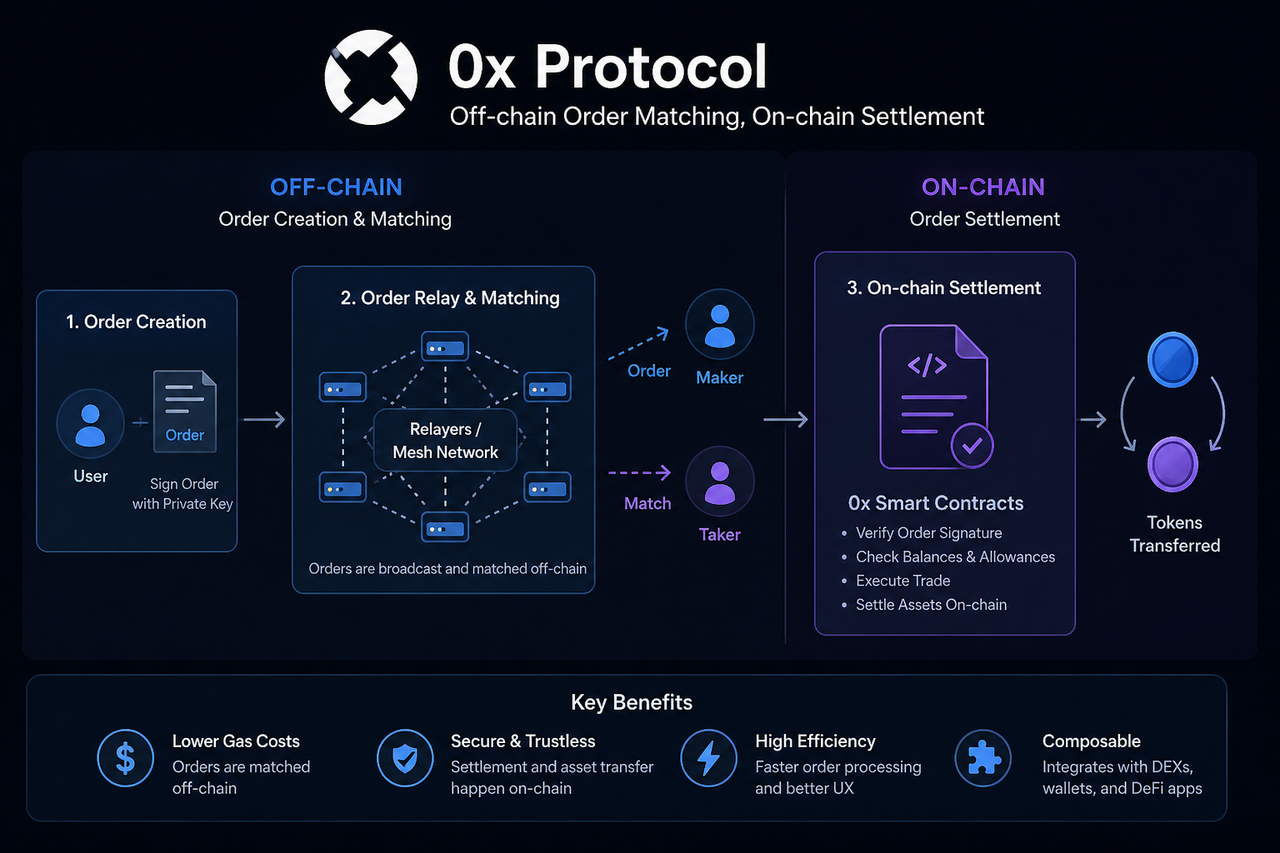
First, users generate orders containing details such as price, amount, and expiration, then sign them with their Private Key. Instead of being immediately submitted to the blockchain, these orders are broadcast off-chain via relayer services. Other market participants or liquidity aggregators can access these orders to seek matching opportunities.
Once an order meets the execution criteria, the matching party submits the signed order to the 0x Smart Contract, which verifies the signature, checks balances, and executes the asset swap. Only the final transaction result is recorded on-chain, minimizing on-chain interactions.
What Is the Off-Chain Order Relay Mechanism?
Off-chain order relay is a core innovation of the 0x Protocol. After an order is created, its data is broadcast off-chain through relayer nodes or the Mesh network—rather than being instantly written to the blockchain.
This method dramatically reduces on-chain writes. Order creation, modification, and cancellation all occur off-chain, with only successful trades requiring on-chain settlement. As a result, trading costs are significantly lowered. For use cases that require frequent order updates, this approach is far more efficient than a fully on-chain Order Book.
Additionally, off-chain broadcasting increases trading flexibility, enabling different applications to share order liquidity and further boosting overall matching efficiency.
How Does On-Chain Settlement Ensure Transaction Security?
Although orders are relayed off-chain, asset swaps are ultimately executed by on-chain Smart Contracts. The 0x Protocol Smart Contract validates order signatures, checks balances and approval limits, and processes trades only when all conditions are satisfied.
This design ensures that off-chain broadcasting does not compromise security. Actual asset transfers are strictly controlled by on-chain Smart Contracts, and only properly signed, valid orders can be executed—eliminating the risk of malicious tampering.
By combining efficiency with the transparency and auditability of blockchain transactions, 0x Protocol enables users to swap assets without relying on intermediaries.
How Does 0x Protocol Reduce Gas Costs?
Traditional on-chain Order Book models require every Maker order, cancellation, or modification to be processed on-chain, resulting in high Gas fees. In contrast, 0x Protocol handles most order-related operations off-chain, with only final settlement occurring on-chain.
This means multiple order status changes can be processed off-chain without using on-chain resources. Users only incur on-chain fees when a trade is actually executed, substantially lowering overall trading costs. This design is especially effective in high-frequency trading environments, significantly improving capital efficiency.
Reduced Gas costs make 0x an ideal foundation for Wallet swaps and trading aggregation services.
How Do the Core Components of 0x Protocol Work Together?
The 0x Protocol operates through several integrated components that collectively enable seamless trade execution: the Relayer, Mesh network, 0x API, and Exchange Proxy.
The Relayer manages order broadcast and relay, the Mesh network shares order data among nodes, the 0x API offers a unified offer interface, and the Exchange Proxy handles on-chain settlement and liquidity routing. When a user submits a trade request, the API aggregates offers from diverse liquidity sources, the order is relayed off-chain, and final settlement is completed by the Smart Contract.
This modular architecture ensures 0x remains open and extensible, while providing Developers with a unified trading interface for streamlined integration.
Why Is This Model Ideal for On-Chain Liquidity Aggregation?
The off-chain matching mechanism of 0x Protocol enables efficient aggregation of liquidity from multiple sources. Since orders don't need to be instantly recorded on-chain, offers from various markets and Makers can be quickly consolidated, allowing the protocol to select the optimal execution path at settlement.
This is especially valuable for Wallets and aggregators, which must source the best prices across different liquidity pools. Relying solely on on-chain matching would drive up costs and reduce efficiency. 0x’s hybrid approach enables rapid price discovery off-chain and secure asset settlement on-chain, balancing efficiency with security.
For this reason, 0x is widely recognized as a critical infrastructure component for on-chain trade aggregation.
Summary
By separating order matching from asset settlement through "off-chain order relay + on-chain settlement," 0x Protocol enables decentralized trading to achieve greater efficiency without compromising security. Off-chain broadcasting minimizes on-chain interactions and reduces Gas costs, while on-chain Smart Contracts guarantee transparent and reliable trade execution.
This design positions 0x as the foundational trading infrastructure for Wallets, DEXs, and DeFi aggregators. Understanding this mechanism provides deeper insight into how on-chain trading systems balance efficiency and decentralization.
FAQs
Why does 0x Protocol use off-chain matching?
Off-chain matching reduces on-chain operations, cutting Gas costs and enhancing order processing efficiency.
Is off-chain order broadcasting secure?
While orders are broadcast off-chain, asset settlement is handled by on-chain Smart Contracts, ensuring transaction security is maintained by the blockchain.
How does 0x Protocol achieve low-cost trading?
By handling Maker orders and updates off-chain and only settling on-chain upon execution, 0x lowers total on-chain fees.
Who executes on-chain settlement in 0x Protocol?
Order validation and asset swaps are handled by 0x Smart Contract components, such as the Exchange Proxy.
What application scenarios is 0x Protocol suitable for?
0x is ideal for Wallet swaps, DEX aggregators, DeFi platforms, and any application that requires on-chain asset swap capabilities.







