This comprehensive analysis compares TRB and FIL, two leading blockchain infrastructure assets with distinct positioning. Tellor (TRB) operates as a decentralized oracle network integrating off-chain data through proof-of-work consensus, while Filecoin (FIL) functions as a decentralized storage solution built on IPFS protocol rewarding storage contributors. The article examines historical price performance, market dynamics, tokenomics, institutional adoption, and technical ecosystems across both assets. Current market data shows TRB trading at $22.67 with $119,047.04 daily volume versus FIL at $1.532 with higher $1,705,776.37 volume, reflecting different market liquidity profiles. Investment recommendations vary by risk profile—conservative investors favor FIL's established position (60-70% allocation), while aggressive investors may increase TRB exposure (50-60%) for potential upside. The analysis provides price forecasts through 2031, risk assessments, and strategic allocation frameworks to help investors m
Introduction: Investment Comparison Between TRB and FIL
In the cryptocurrency market, the comparison between TRB and FIL has consistently been a topic of interest for investors. Both assets exhibit notable differences in market capitalization ranking, application scenarios, and price performance, while representing distinct positioning within the crypto asset landscape.
Tellor (TRB): Launched in November 2019, TRB has gained market recognition as a decentralized oracle network platform designed to integrate high-value off-chain data into Ethereum through its proof-of-work consensus mechanism.
Filecoin (FIL): Introduced in October 2020, FIL has established itself as a decentralized storage solution built on the IPFS protocol, rewarding participants who contribute idle hard drive capacity to the network.
This article will comprehensively analyze the investment value comparison between TRB and FIL through multiple dimensions including historical price trends, supply mechanisms, institutional adoption, technical ecosystems, and future projections, while attempting to address the question investors care about most:
"Which asset presents more compelling investment characteristics based on current market dynamics?"
I. Historical Price Comparison and Current Market Status
Historical Price Trends of TRB and FIL
- 2021: TRB experienced notable price volatility, with its all-time high recorded at $593.09 in January 2024, reflecting significant market interest during that period.
- 2021: FIL reached its all-time high of $236.84 in April 2021, driven by growing adoption of decentralized storage solutions and strong market momentum.
- Comparative Analysis: During the subsequent market cycles, TRB declined from its peak of $593.09 to its current trading level, representing a substantial correction. Similarly, FIL experienced a decline from its high of $236.84, with both assets showing significant retracements from their respective peaks.
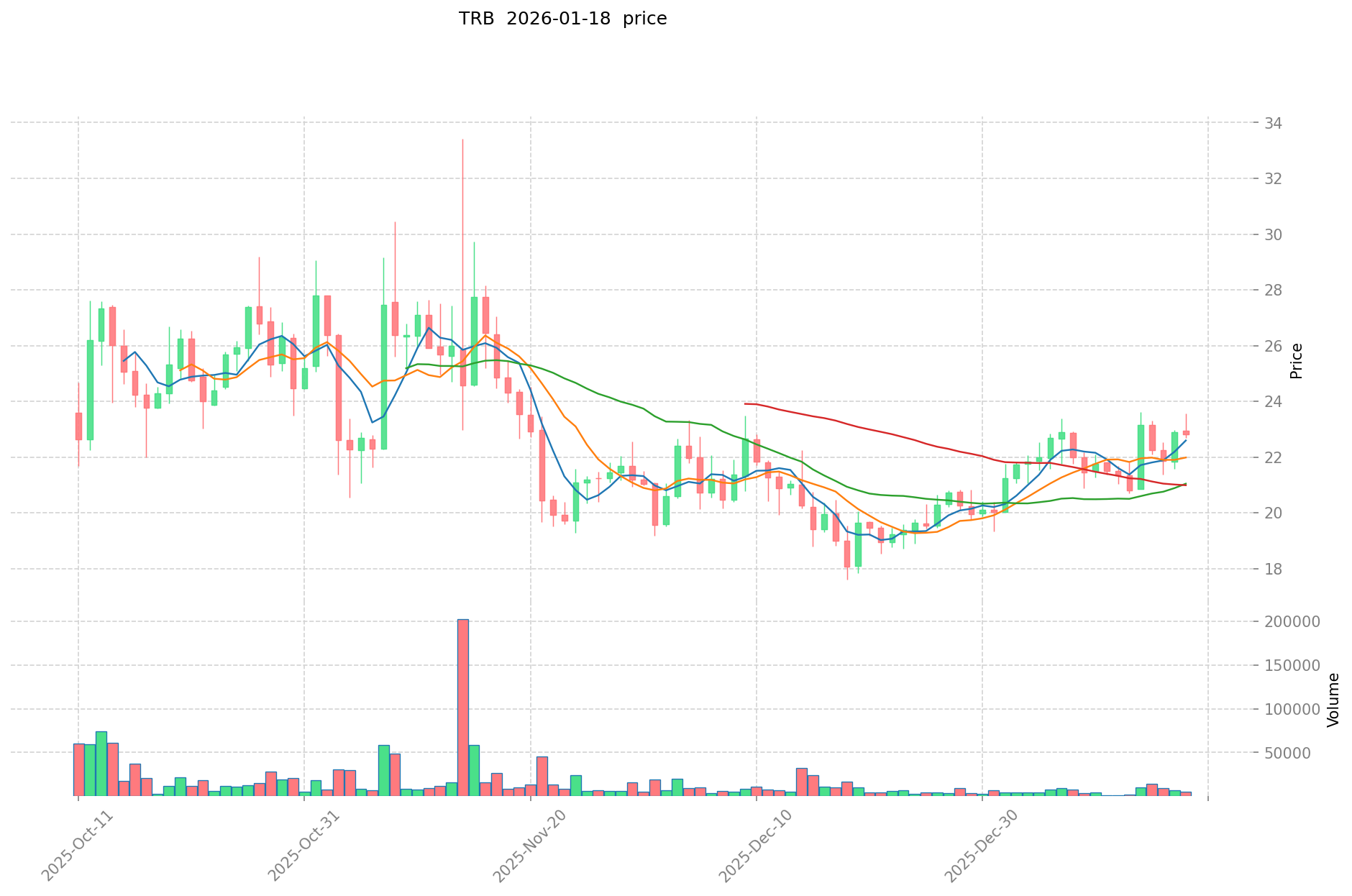
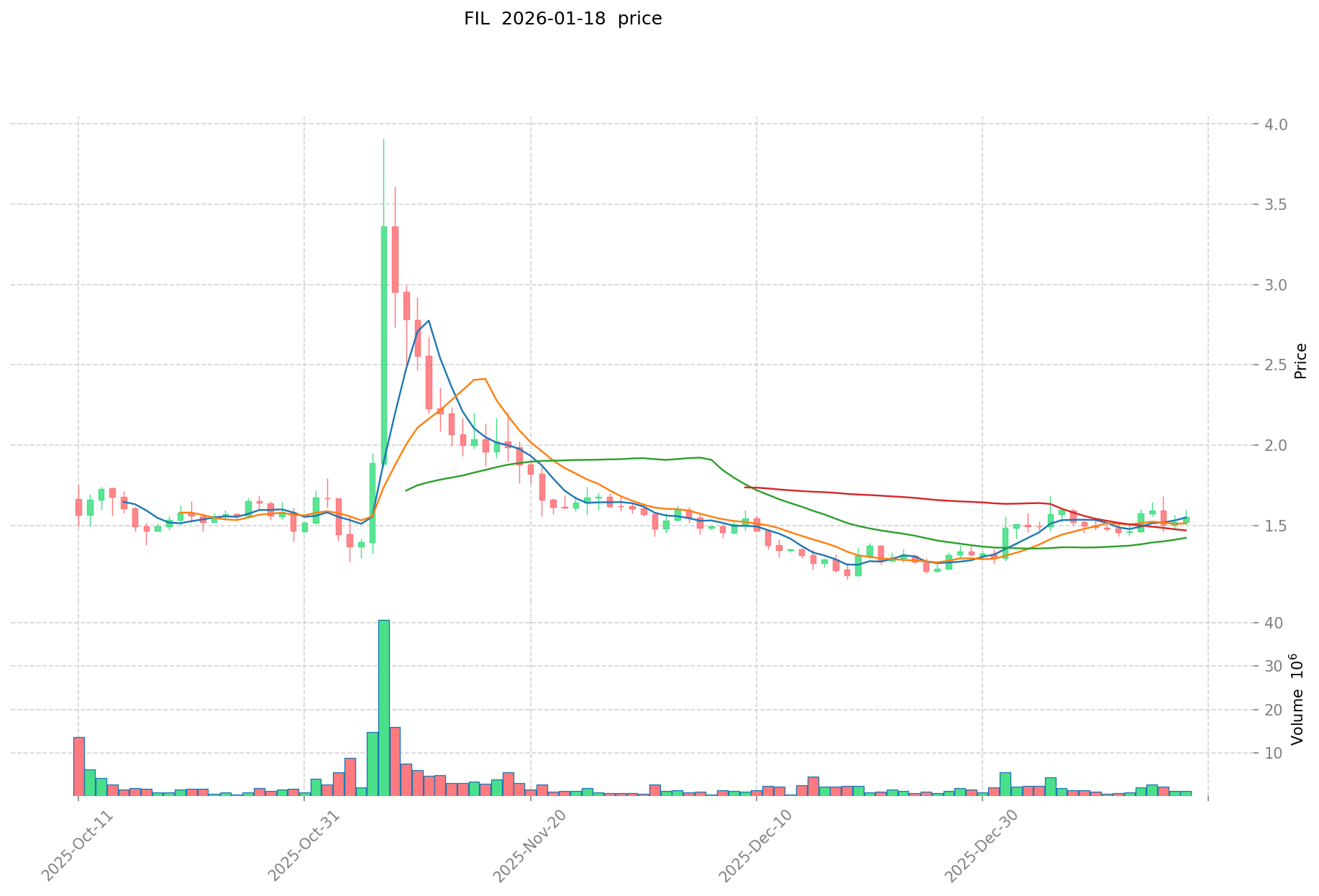
Current Market Status (2026-01-19)
- TRB Current Price: $22.67
- FIL Current Price: $1.532
- 24-Hour Trading Volume: TRB recorded $119,047.04 compared to FIL's $1,705,776.37
- Fear & Greed Index: 49 (Neutral)
View real-time prices:
II. Core Factors Influencing TRB vs FIL Investment Value
Supply Mechanism Comparison (Tokenomics)
- TRB: The materials do not provide specific information regarding TRB's supply mechanism or tokenomics structure.
- FIL: Filecoin's valuation is influenced by multiple factors including market demand, supply volume, project development, macroeconomic factors, and market conditions. As a representative of decentralized storage solutions, its value proposition is tied to network utility and adoption patterns.
- 📌 Historical Pattern: Supply mechanisms can influence price cycles through scheduled emissions, vesting schedules, and demand-supply dynamics in the broader market context.
Institutional Adoption and Market Application
- Institutional Holdings: Based on available materials, fundamental analysis for Tellor Tributes emphasizes examining network adoption status and institutional investment as key considerations, alongside macroeconomic factors.
- Enterprise Adoption: The materials do not provide detailed comparisons of TRB and FIL adoption in cross-border payments, settlement systems, or institutional investment portfolios.
- National Policies: Regulatory attitudes toward these assets vary across jurisdictions, though specific policy frameworks are not detailed in the provided materials.
Technology Development and Ecosystem Building
- TRB Technology Development: Specific technical upgrades and their potential impacts are not detailed in the available materials.
- FIL Technology Development: Filecoin positions itself as a decentralized storage solution, with its value proposition centered on providing distributed data storage infrastructure.
- Ecosystem Comparison: The materials do not provide comprehensive comparisons of DeFi integration, NFT support, payment applications, or smart contract implementations for these two assets.
Macroeconomic Conditions and Market Cycles
- Performance in Inflationary Environments: The materials indicate that both assets' valuations are subject to macroeconomic factors, though specific anti-inflation characteristics are not detailed.
- Macroeconomic Monetary Policy: Interest rates, dollar index movements, and broader monetary policy shifts can influence crypto asset valuations, including TRB and FIL.
- Geopolitical Factors: Cross-border transaction demand and international developments may affect adoption and usage patterns, though specific impacts on these two assets are not elaborated in the materials.
III. 2026-2031 Price Forecast: TRB vs FIL
Short-Term Forecast (2026)
- TRB: Conservative $21.54-$22.67 | Optimistic $22.67-$28.56
- FIL: Conservative $0.84-$1.56 | Optimistic $1.56-$1.63
Medium-Term Forecast (2028-2029)
- TRB may enter a consolidation phase, with projected price range of $26.34-$32.68
- FIL may enter a growth phase, with projected price range of $1.27-$3.15
- Key drivers: institutional capital inflows, ETF developments, ecosystem expansion
Long-Term Forecast (2030-2031)
- TRB: Baseline scenario $24.92-$37.61 | Optimistic scenario $34.61-$48.11
- FIL: Baseline scenario $2.25-$3.85 | Optimistic scenario $3.26-$4.31
View detailed price predictions for TRB and FIL
Disclaimer
TRB:
| Year |
Predicted High Price |
Predicted Average Price |
Predicted Low Price |
Price Change |
| 2026 |
28.5642 |
22.67 |
21.5365 |
0 |
| 2027 |
32.277546 |
25.6171 |
13.320892 |
13 |
| 2028 |
32.13152853 |
28.947323 |
26.34206393 |
27 |
| 2029 |
32.67718556855 |
30.539425765 |
18.62904971665 |
34 |
| 2030 |
37.61388374346225 |
31.608305666775 |
27.815308986762 |
39 |
| 2031 |
48.109421640114888 |
34.611094705118625 |
24.91998818768541 |
52 |
FIL:
| Year |
Predicted High Price |
Predicted Average Price |
Predicted Low Price |
Price Change |
| 2026 |
1.6338 |
1.556 |
0.84024 |
1 |
| 2027 |
2.200962 |
1.5949 |
1.499206 |
4 |
| 2028 |
2.50526892 |
1.897931 |
1.27161377 |
23 |
| 2029 |
3.1482879428 |
2.20159996 |
1.9374079648 |
43 |
| 2030 |
3.851919290016 |
2.6749439514 |
2.353950677232 |
74 |
| 2031 |
4.30772973933456 |
3.263431620708 |
2.25176781828852 |
113 |
IV. Investment Strategy Comparison: TRB vs FIL
Long-Term vs Short-Term Investment Strategies
- TRB: May appeal to investors focusing on oracle infrastructure development and network adoption dynamics, with consideration for higher volatility characteristics in shorter timeframes.
- FIL: May appeal to investors interested in decentralized storage solutions and distributed infrastructure, with attention to long-term ecosystem development patterns.
Risk Management and Asset Allocation
- Conservative Investors: TRB 30-40% vs FIL 60-70%
- Aggressive Investors: TRB 50-60% vs FIL 40-50%
- Hedging Tools: stablecoin allocation, options strategies, cross-asset diversification approaches
V. Potential Risk Comparison
Market Risks
- TRB: Price volatility patterns have shown significant fluctuations, with substantial corrections observed from previous price levels, potentially influenced by market sentiment shifts and liquidity conditions.
- FIL: Market dynamics reflect broader trends in decentralized storage adoption, with valuation influenced by supply-demand equilibrium, network utilization rates, and competitive landscape developments.
Technical Risks
- TRB: Network scalability considerations, oracle data reliability, and operational stability factors may influence long-term value proposition.
- FIL: Storage network expansion challenges, technical implementation complexities, and infrastructure security considerations warrant ongoing evaluation.
Regulatory Risks
- Global regulatory frameworks continue evolving, with varying approaches across jurisdictions potentially affecting both assets' operational environments and market accessibility differently based on their distinct functional characteristics.
VI. Conclusion: Which Is the Better Buy?
📌 Investment Value Summary:
- TRB Characteristics: Positioned as oracle infrastructure with specific use cases in data integration, showing historical price volatility patterns that may present opportunities for risk-tolerant participants.
- FIL Characteristics: Represents decentralized storage infrastructure with utility-driven value proposition, potentially benefiting from growing data storage demands and distributed network adoption trends.
✅ Investment Considerations:
- Novice Investors: Consider starting with smaller position sizes, focusing on understanding fundamental differences between oracle networks and storage solutions, while maintaining diversified exposure across multiple asset classes.
- Experienced Investors: Evaluate technical fundamentals, ecosystem development trajectories, and tokenomics structures alongside broader market cycle positioning when determining allocation strategies.
- Institutional Investors: Assess infrastructure utility, network adoption metrics, regulatory compliance considerations, and integration potential within existing technology frameworks as primary evaluation criteria.
⚠️ Risk Disclosure: Cryptocurrency markets exhibit substantial volatility. This analysis does not constitute investment advice. Participants should conduct independent research and consider personal risk tolerance before making investment decisions.
VII. FAQ
Q1: What are the primary functional differences between TRB and FIL?
TRB functions as a decentralized oracle network providing off-chain data to Ethereum smart contracts, while FIL operates as a decentralized storage solution built on IPFS protocol. TRB utilizes proof-of-work consensus to secure data feeds and enable smart contracts to access real-world information, positioning it within the blockchain infrastructure layer for data integration. Conversely, FIL incentivizes participants to contribute unused storage capacity, creating a distributed data storage marketplace that competes with traditional cloud storage solutions. These fundamental differences mean TRB's value proposition centers on data reliability and oracle network adoption, while FIL's valuation correlates with storage demand, network utilization rates, and the broader adoption of decentralized storage infrastructure.
Q2: How do current market valuations compare between TRB and FIL?
As of January 19, 2026, TRB trades at $22.67 while FIL trades at $1.532, representing significant declines from their respective all-time highs. TRB's 24-hour trading volume stands at $119,047.04 compared to FIL's substantially higher volume of $1,705,776.37, indicating greater market liquidity and trading activity for FIL. Both assets have experienced considerable retracements from peak levels—TRB from $593.09 (January 2024) and FIL from $236.84 (April 2021). The current market neutral sentiment (Fear & Greed Index: 49) suggests balanced investor positioning. The substantial difference in trading volumes reflects FIL's broader market recognition and more established trading infrastructure, while TRB demonstrates lower liquidity characteristics typical of specialized oracle infrastructure projects.
Q3: What factors should investors consider when choosing between TRB and FIL?
Investment decisions should prioritize understanding each asset's fundamental value drivers, risk profiles, and alignment with portfolio objectives. For TRB, key considerations include oracle network adoption rates, data integration use cases, competition from alternative oracle solutions, and the technical reliability of its proof-of-work mechanism. FIL evaluation should focus on decentralized storage market growth, network storage capacity utilization, competitive positioning against centralized cloud providers, and the broader adoption trajectory of IPFS-based solutions. Additionally, investors must assess liquidity differences—FIL's higher trading volume suggests easier entry and exit positioning, while TRB's lower liquidity may result in higher price volatility and potential slippage. Risk tolerance, investment timeframe, and conviction in either oracle infrastructure or decentralized storage thesis should guide allocation decisions rather than short-term price movements.
Q4: What are the projected price trajectories for TRB and FIL through 2031?
Short-term forecasts (2026) suggest TRB may trade between $21.54-$28.56 under varying scenarios, while FIL projects a range of $0.84-$1.63. Medium-term projections (2028-2029) anticipate TRB consolidating within $26.34-$32.68, while FIL potentially enters a growth phase targeting $1.27-$3.15, driven by institutional adoption and ecosystem expansion. Long-term estimates (2030-2031) project TRB reaching $24.92-$48.11 depending on market conditions, with FIL targeting $2.25-$4.31 under baseline and optimistic scenarios. These forecasts incorporate assumptions about market cycles, institutional capital inflows, technological developments, and macroeconomic conditions. However, cryptocurrency markets exhibit substantial uncertainty, and actual outcomes may deviate significantly from projections based on unforeseen regulatory changes, technological disruptions, competitive dynamics, or shifts in market sentiment that models cannot accurately anticipate.
Q5: How do recommended portfolio allocations differ between conservative and aggressive investors?
Conservative investors may consider allocating 30-40% to TRB and 60-70% to FIL, prioritizing FIL's more established market position, higher liquidity, and broader adoption trajectory in the decentralized storage sector. This allocation acknowledges FIL's relatively lower volatility profile and more predictable value drivers tied to storage demand growth. Aggressive investors might reverse this allocation to 50-60% TRB and 40-50% FIL, accepting higher volatility and lower liquidity in exchange for potential upside from oracle network adoption acceleration and TRB's smaller market capitalization offering greater percentage gain potential. Both strategies should incorporate risk management tools including stablecoin reserves for market downturns, options strategies for downside protection, and diversification across additional crypto assets beyond TRB and FIL. Position sizing should reflect individual risk tolerance, liquidity needs, investment timeframe, and conviction levels in oracle versus storage infrastructure investment theses.
Q6: What are the primary risks associated with investing in TRB versus FIL?
TRB faces specific risks including oracle network scalability limitations, data reliability concerns affecting smart contract applications, competition from established oracle providers, and lower market liquidity potentially amplifying price volatility during market stress periods. The oracle sector's technical complexity and narrow use case focus may limit adoption compared to broader infrastructure categories. FIL encounters different risk factors including storage network expansion challenges, competition from both centralized cloud providers and alternative decentralized storage solutions, technical implementation complexities in achieving seamless IPFS integration, and dependency on sustained growth in decentralized storage demand. Both assets face common cryptocurrency market risks including regulatory uncertainty across jurisdictions, macroeconomic headwinds affecting risk asset valuations, technological obsolescence threats, and market manipulation concerns in lower liquidity environments. Regulatory frameworks continue evolving with varying approaches potentially affecting operational environments differently based on functional characteristics—oracle networks versus storage infrastructure may face distinct compliance requirements.
Q7: How do macroeconomic conditions and market cycles influence TRB and FIL valuations?
Both TRB and FIL demonstrate sensitivity to macroeconomic factors including interest rate policies, dollar index movements, inflation expectations, and broader risk asset sentiment, though their specific responses may differ based on fundamental characteristics. Rising interest rates typically pressure crypto valuations by increasing opportunity costs and reducing liquidity, while dollar strength often correlates with crypto weakness through inverse relationships. Market cycles significantly impact both assets—bull markets driven by institutional capital inflows, ETF developments, and ecosystem expansion tend to lift valuations across both oracle and storage infrastructure categories, while bear markets amplify downside through liquidity withdrawal and risk aversion. Geopolitical developments affecting cross-border transactions, data sovereignty concerns, or decentralization narratives may create asymmetric impacts—storage solutions like FIL potentially benefiting from data localization trends, while oracle networks like TRB gaining from increased smart contract complexity requiring reliable external data feeds. Understanding these macro dynamics helps investors time entries and exits while maintaining realistic expectations during different cycle phases.
Q8: What technical and ecosystem developments could drive future value appreciation?
TRB's value appreciation potential correlates with expanding oracle network adoption, successful integration with major DeFi protocols requiring reliable price feeds, improvements in data accuracy and response times, and broader recognition of oracle infrastructure as critical blockchain middleware. Ecosystem growth through developer tools, documentation, and partnership announcements with prominent blockchain projects could catalyze increased network utilization and token demand. FIL's upside drivers include growing decentralized storage adoption by enterprises and Web3 applications, successful implementation of retrieval markets improving user experience, storage capacity expansion demonstrating network scalability, and integration with NFT platforms, metaverse projects, and data-intensive applications requiring distributed storage solutions. Both assets benefit from broader cryptocurrency market maturation, institutional infrastructure development, regulatory clarity providing operational certainty, and technological innovations improving usability and performance. Monitoring development activity, partnership announcements, network utilization metrics, and community engagement provides insight into ecosystem health and potential value trajectory beyond price speculation alone.
* The information is not intended to be and does not constitute financial advice or any other recommendation of any sort offered or endorsed by Gate.