This comprehensive analysis compares JST and VET, two distinct blockchain assets with different applications and investment profiles. JST, a TRON-based DeFi token launched in 2020, focuses on decentralized lending and governance mechanisms, currently trading at $0.0407. VET, an enterprise-grade supply chain solution founded in 2015, powers supply chain transparency and anti-counterfeiting initiatives through partnerships with major organizations, currently at $0.012113. The article examines historical price movements, tokenomics, institutional adoption, technological ecosystems, and price forecasts through 2031. It addresses key investor concerns by providing risk analysis, allocation strategies for different investor profiles, and detailed comparisons across market performance, technology development, and regulatory considerations. Detailed price predictions and FAQ sections help investors determine which asset aligns with their investment objectives and risk tolerance.
Introduction: JST vs VET Investment Comparison
In the cryptocurrency market, the comparison between JST vs VET has been a recurring topic among investors. These two assets exhibit notable differences in market cap ranking, application scenarios, and price performance, representing distinct positioning within the crypto asset landscape.
JST (JST): Launched in 2020, JST has gained market recognition for its decentralized finance system aimed at providing stablecoin lending and governance mechanisms for global users.
VET (VET): Founded in 2015 by Sunny Lu, VET has been recognized for its enterprise-grade blockchain solutions focused on supply chain transparency and anti-counterfeiting, establishing partnerships with major organizations such as DNV, Walmart, and Boston Consulting Group.
This article will provide a comprehensive analysis of JST vs VET investment value comparison, examining historical price movements, supply mechanisms, institutional adoption, technological ecosystems, and future forecasts, while attempting to address the most pressing question for investors:
"Which is the better buy right now?"
I. Historical Price Comparison and Current Market Status
Historical Price Trends of JST (Coin A) and VET (Coin B)
- 2021: JST reached its all-time high of $0.193254 on April 5, 2021, driven by increased activity within the TRON-based DeFi ecosystem and growing adoption of its USDJ stablecoin platform.
- 2020: VET experienced significant volatility, recording its all-time low of $0.00191713 on March 13, 2020, amid broader market downturns during the early pandemic period.
- 2021: VET peaked at $0.280991 on April 19, 2021, benefiting from enterprise partnerships with organizations such as DNV, Walmart, and BCG, which validated its supply chain solutions.
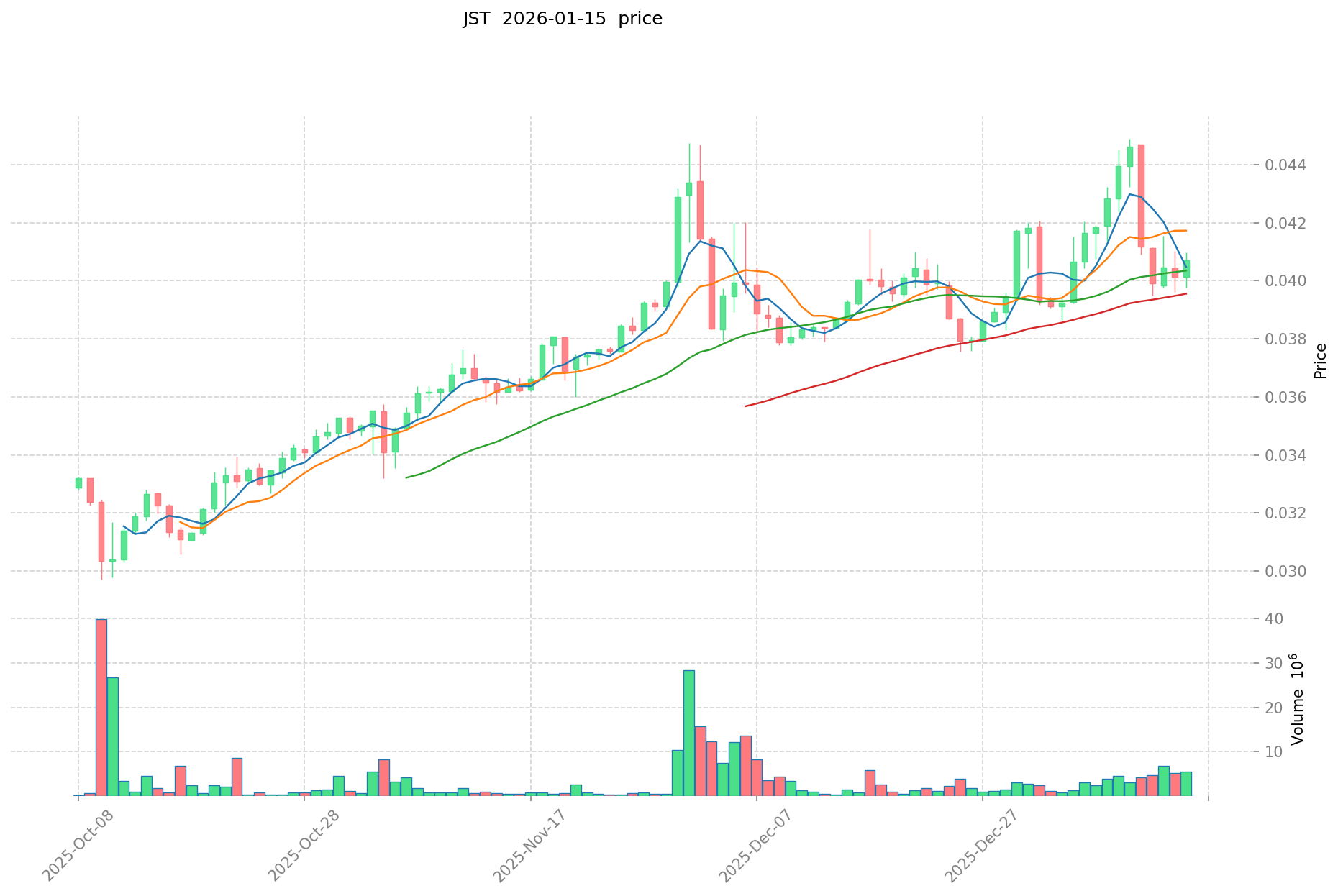
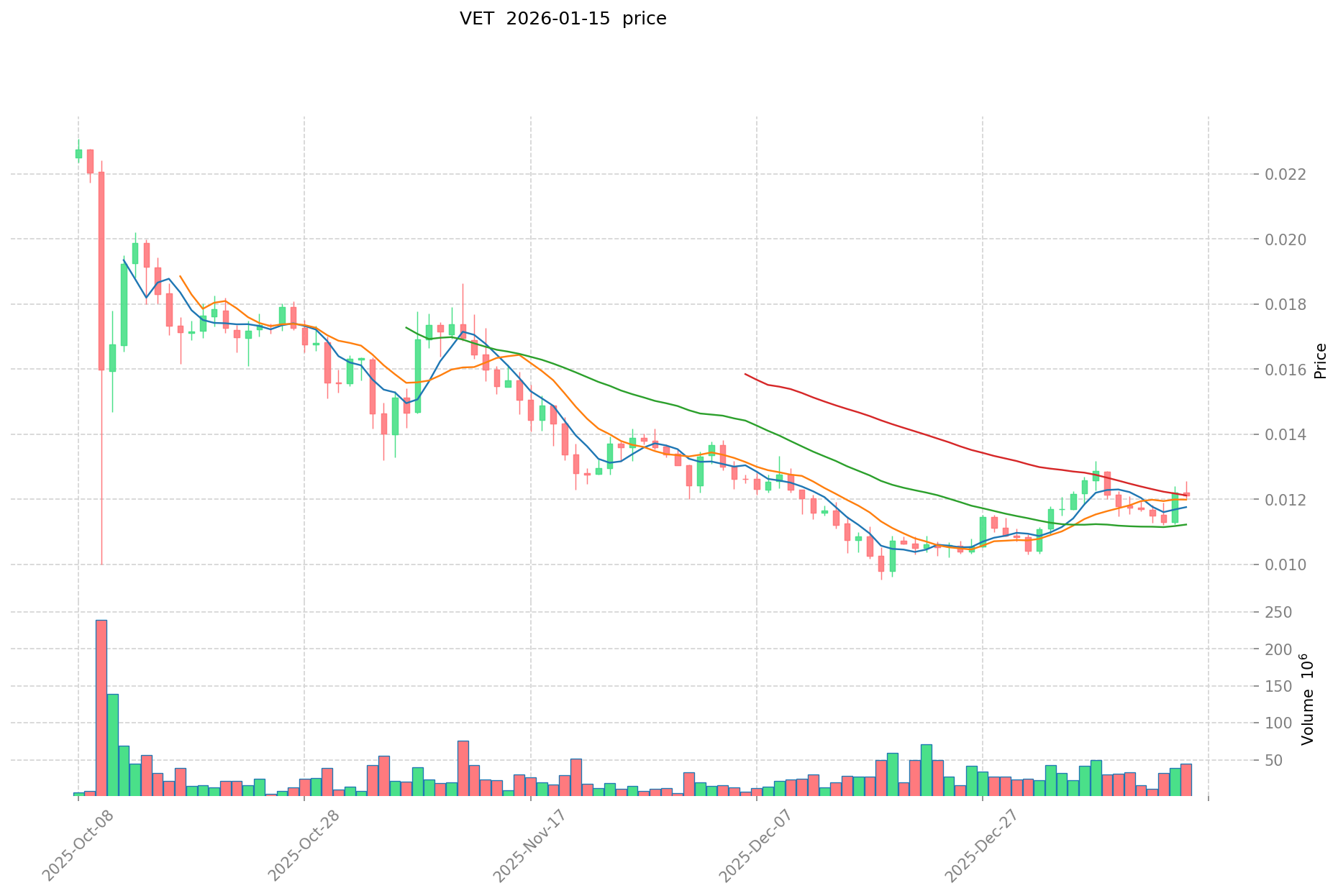
- Comparative Analysis: During the 2021 bull market cycle, JST rose from its historical low of $0.00476275 (May 9, 2020) to its peak of $0.193254, representing substantial growth. In contrast, VET demonstrated even more dramatic price movement, climbing from $0.00191713 to $0.280991 during the same period. However, both assets experienced significant corrections in subsequent market cycles, with JST declining approximately 78.95% from its all-time high to the current price level, while VET decreased approximately 95.69%.
Current Market Status (2026-01-15)
- JST Current Price: $0.0407
- VET Current Price: $0.012113
- 24-Hour Trading Volume: JST recorded $222,634.98, while VET demonstrated higher liquidity with $548,536.47
- Market Sentiment Index (Fear & Greed Index): 48 (Neutral)
View Real-Time Prices:
II. Core Factors Influencing JST vs VET Investment Value
Supply Mechanism Comparison (Tokenomics)
- JST: The supply mechanism details are not extensively covered in available materials, though JST operates within the TRON ecosystem where token economics typically involve staking and governance mechanisms.
- VET: VET functions as part of a dual-token system within the VeChain ecosystem, designed to support supply chain and logistics applications with a structured token distribution model.
- 📌 Historical Pattern: Supply mechanisms can influence price cycles through token release schedules, staking rewards, and ecosystem demand dynamics, though specific historical data for these tokens requires further observation.
Institutional Adoption and Market Application
- Institutional Holdings: Current materials do not provide specific data on institutional preference between JST and VET.
- Enterprise Adoption: VET demonstrates utility in supply chain logistics and enterprise blockchain applications, while JST serves functions within decentralized finance on the TRON network. Cross-border payment and settlement applications vary based on ecosystem focus.
- National Policies: Regulatory attitudes toward these tokens differ across jurisdictions, with VET potentially benefiting from enterprise blockchain adoption in regions supporting supply chain innovation.
Technology Development and Ecosystem Building
- JST Technology: JST utilizes machine learning for price prediction mechanisms and operates within the TRON DeFi ecosystem, supporting lending and staking functionalities.
- VET Technology: VET is positioned within a broader enterprise-focused blockchain ecosystem, emphasizing supply chain transparency, product traceability, and IoT integration.
- Ecosystem Comparison: JST participates in DeFi protocols including lending platforms like JustLend, while VET focuses on enterprise partnerships and supply chain verification applications. Both tokens serve distinct ecosystem niches with different implementation priorities.
Macroeconomic Environment and Market Cycles
- Inflation Environment Performance: Neither token demonstrates established historical correlation with inflation hedging, as both remain subject to broader cryptocurrency market volatility.
- Macroeconomic Monetary Policy: Interest rate changes and US dollar index movements influence cryptocurrency markets broadly, affecting both JST and VET through liquidity conditions and risk appetite shifts.
- Geopolitical Factors: Cross-border transaction demand and international developments can impact both tokens differently based on their respective use cases, with VET potentially benefiting from international supply chain disruptions requiring transparency solutions.
III. 2026-2031 Price Prediction: JST vs VET
Short-term Prediction (2026)
- JST: Conservative $0.0370-$0.0406 | Optimistic $0.0406-$0.0487
- VET: Conservative $0.0116-$0.0121 | Optimistic $0.0121-$0.0127
Mid-term Prediction (2028-2029)
- JST may enter a consolidation phase, with estimated price range of $0.0391-$0.0692
- VET may enter a moderate growth phase, with estimated price range of $0.0086-$0.0159
- Key drivers: institutional capital inflows, ETF developments, ecosystem expansion
Long-term Prediction (2030-2031)
- JST: Baseline scenario $0.0458-$0.0703 | Optimistic scenario $0.0663-$0.0858
- VET: Baseline scenario $0.0111-$0.0201 | Optimistic scenario $0.0155-$0.0215
View detailed price predictions for JST and VET
Disclaimer
JST:
| Year |
Predicted High Price |
Predicted Average Price |
Predicted Low Price |
Price Change |
| 2026 |
0.048732 |
0.04061 |
0.0369551 |
0 |
| 2027 |
0.0625394 |
0.044671 |
0.02858944 |
9 |
| 2028 |
0.05896572 |
0.0536052 |
0.039131796 |
31 |
| 2029 |
0.0692311158 |
0.05628546 |
0.0529083324 |
38 |
| 2030 |
0.070289282448 |
0.0627582879 |
0.045813550167 |
54 |
| 2031 |
0.08581568287446 |
0.066523785174 |
0.04457093606658 |
63 |
VET:
| Year |
Predicted High Price |
Predicted Average Price |
Predicted Low Price |
Price Change |
| 2026 |
0.01271445 |
0.012109 |
0.01162464 |
0 |
| 2027 |
0.0166317115 |
0.012411725 |
0.00682644875 |
2 |
| 2028 |
0.0155382385275 |
0.01452171825 |
0.010746071505 |
19 |
| 2029 |
0.015931777092075 |
0.01502997838875 |
0.008567087681587 |
24 |
| 2030 |
0.020125141062536 |
0.015480877740412 |
0.011146231973097 |
27 |
| 2031 |
0.021541641375784 |
0.017803009401474 |
0.01388634733315 |
46 |
IV. Investment Strategy Comparison: JST vs VET
Long-term vs Short-term Investment Strategies
- JST: May suit investors interested in DeFi ecosystem exposure and TRON-based lending protocols, with focus on decentralized finance infrastructure development
- VET: May suit investors seeking enterprise blockchain adoption and supply chain application scenarios, with emphasis on real-world business integration
Risk Management and Asset Allocation
- Conservative Investors: JST 30-40% vs VET 60-70%
- Aggressive Investors: JST 50-60% vs VET 40-50%
- Hedging Tools: stablecoin allocation, options strategies, cross-asset portfolio combinations
V. Potential Risk Comparison
Market Risk
- JST: Subject to DeFi sector volatility, TRON ecosystem development dependency, and stablecoin market dynamics affecting platform utilization
- VET: Influenced by enterprise adoption cycles, supply chain industry trends, and corporate partnership sustainability
Technology Risk
- JST: Scalability considerations within TRON network, smart contract security on lending platforms
- VET: Dual-token system complexity, enterprise integration technical barriers
Regulatory Risk
- Global regulatory policies affect both assets differently, with JST potentially facing DeFi-focused regulations while VET may encounter enterprise blockchain compliance requirements across jurisdictions
VI. Conclusion: Which Is the Better Buy?
📌 Investment Value Summary:
- JST Advantages: Participation in DeFi lending ecosystem, integration with TRON network infrastructure, stablecoin platform functionality
- VET Advantages: Enterprise partnerships with established organizations, supply chain verification applications, dual-token economic model supporting ecosystem operations
✅ Investment Recommendations:
- Novice Investors: Consider diversified allocation between both assets with emphasis on understanding distinct use cases and ecosystem fundamentals
- Experienced Investors: Evaluate portfolio positioning based on DeFi exposure preferences versus enterprise blockchain adoption thesis
- Institutional Investors: Assess alignment with investment mandate regarding DeFi protocols versus enterprise-grade blockchain solutions
⚠️ Risk Disclaimer: Cryptocurrency markets exhibit substantial volatility. This content does not constitute investment advice.
VII. FAQ
Q1: Which cryptocurrency has better historical performance - JST or VET?
VET demonstrated stronger historical price appreciation, rising from $0.00191713 (March 2020) to its all-time high of $0.280991 (April 2021), representing a more dramatic percentage gain compared to JST's movement from $0.00476275 (May 2020) to $0.193254 (April 2021). However, both assets experienced significant corrections afterward, with JST declining approximately 78.95% from its peak while VET decreased approximately 95.69%, indicating that VET exhibited greater volatility in both upward and downward price movements.
Q2: What are the fundamental differences in use cases between JST and VET?
JST operates within the TRON-based decentralized finance ecosystem, focusing on stablecoin lending platforms like USDJ and governance mechanisms for DeFi protocols such as JustLend. In contrast, VET serves enterprise-grade blockchain applications with emphasis on supply chain transparency, product traceability, and anti-counterfeiting solutions, maintaining partnerships with major organizations including DNV, Walmart, and Boston Consulting Group. This fundamental distinction positions JST as a DeFi infrastructure token while VET functions as an enterprise blockchain solution.
Q3: Which token has higher current trading liquidity?
As of January 15, 2026, VET demonstrates superior trading liquidity with 24-hour trading volume of $548,536.47, compared to JST's $222,634.98. This approximately 2.5x difference in trading volume suggests VET maintains higher market activity and potentially offers better price execution for larger transactions. Higher liquidity generally indicates stronger market interest and can reduce slippage during trading operations.
Q4: What is the price outlook for JST and VET through 2031?
For short-term 2026 projections, JST shows conservative estimates of $0.0370-$0.0406 with optimistic scenarios reaching $0.0487, while VET conservative estimates range $0.0116-$0.0121 with optimistic scenarios at $0.0127. Long-term 2031 predictions indicate JST could reach $0.0663-$0.0858 under optimistic conditions, whereas VET may achieve $0.0155-$0.0215. These forecasts suggest JST maintains higher absolute price levels, though percentage growth potential varies based on market conditions, institutional adoption, and ecosystem development trajectories.
Q5: How should investors allocate between JST and VET based on risk tolerance?
Conservative investors may consider a 30-40% JST and 60-70% VET allocation, emphasizing VET's enterprise adoption stability and established corporate partnerships. Aggressive investors might prefer 50-60% JST and 40-50% VET allocation, capitalizing on DeFi ecosystem growth potential and higher volatility opportunities. This allocation framework accounts for JST's DeFi-focused risk profile versus VET's enterprise blockchain positioning, though all cryptocurrency investments carry substantial volatility risks regardless of allocation strategy.
Q6: What are the primary technology risks distinguishing JST from VET?
JST faces technology risks related to TRON network scalability, smart contract security vulnerabilities on lending platforms, and dependency on DeFi protocol adoption rates. VET encounters different technical challenges including dual-token system complexity, enterprise integration barriers requiring coordination with existing corporate infrastructure, and scalability requirements for large-scale supply chain implementations. Both tokens carry blockchain-specific risks, though JST's risks concentrate in DeFi protocol security while VET's challenges center on enterprise adoption technical hurdles.
Q7: How do regulatory environments differently impact JST versus VET?
JST faces regulatory scrutiny primarily affecting decentralized finance protocols, including potential restrictions on lending platforms, stablecoin operations, and DeFi governance mechanisms across various jurisdictions. VET encounters enterprise blockchain compliance requirements, supply chain verification standards, and corporate partnership regulatory frameworks that vary by industry and geography. The regulatory landscape affects these tokens through distinct pathways - JST through DeFi-focused regulations and VET through enterprise blockchain adoption policies - making their regulatory risk profiles fundamentally different despite both operating within the cryptocurrency sector.
Q8: Which token offers better institutional adoption prospects?
VET demonstrates clearer institutional adoption pathways through established enterprise partnerships with DNV, Walmart, and Boston Consulting Group, positioning it within supply chain management and corporate blockchain solutions. JST's institutional prospects center on DeFi protocol adoption and TRON ecosystem growth, appealing to investors seeking decentralized finance infrastructure exposure. While VET's current enterprise partnerships provide tangible adoption evidence, JST's institutional potential depends on broader DeFi sector acceptance and TRON network development, representing different institutional investment theses with distinct risk-reward profiles.
* The information is not intended to be and does not constitute financial advice or any other recommendation of any sort offered or endorsed by Gate.